

India’s net-zero journey: Early renewable wins, coal challenges and the road to 2070
From early non-fossil milestones to complex coal dependence, India’s climate path reflects a developing economy’s dilemma
India’s net-zero journey: Early renewable wins, coal challenges and the road to 2070
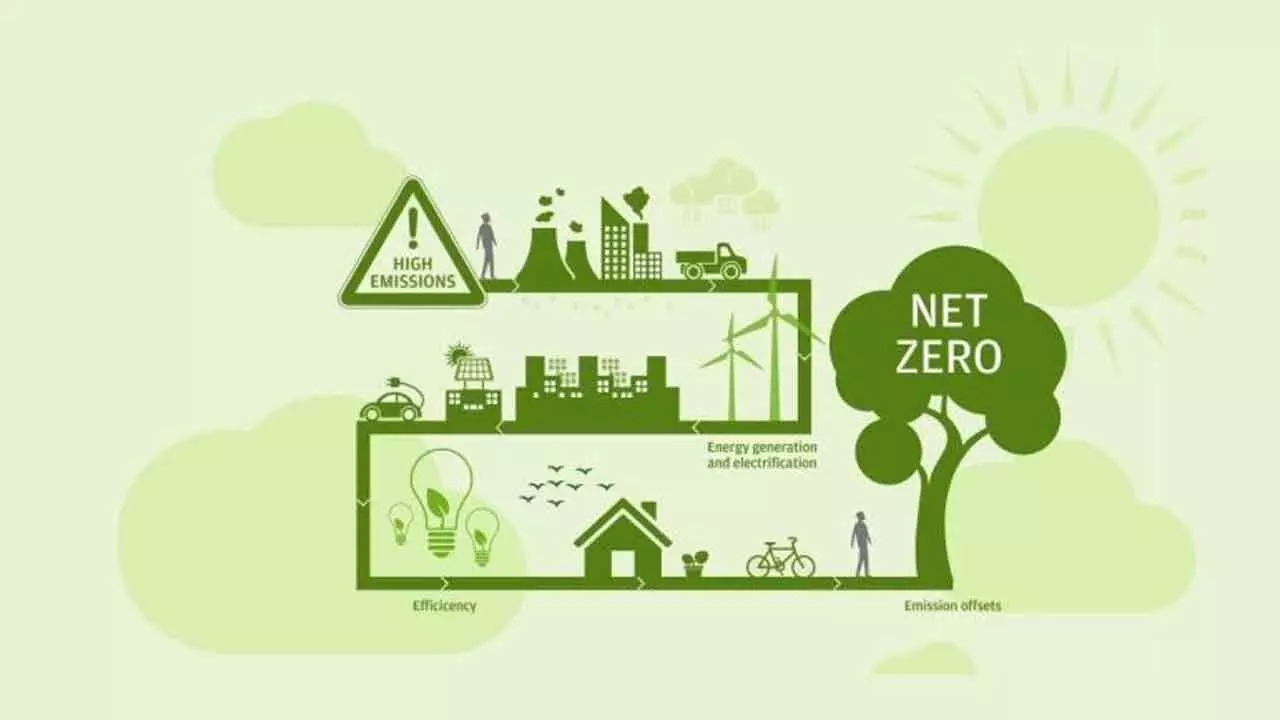

India’s climate journey under Prime Minister Narendra Modi’s leadership reflects a complex balance between ambition and reality.
Having committed at COP26 to achieve net-zero emissions by 2070 through the Panchamrit framework, India has delivered notable early gains—most prominently achieving 50 per cent non-fossil electricity capacity five years ahead of schedule and rapidly scaling solar power nationwide
India, under the leadership of Prime Minister Modi, has declared a net-zero target at COP 26, aiming to achieve Carbon Neutrality by 2070. This has to be supported by " Panchamrit" (five-point) climate commitments, namely,
1. Net Zero by 2070: The overarching goal is to balance carbon emissions with removals by mid-century
2. 50% Renewable Energy: Meeting half of energy needs from non-fossil sources by 2030
3.Emission Reduction: Cutting total projected carbon emissions by 1 billion tonnes by 2030
4. Carbon Intensity: Reduce the economy's carbon Intensity by over 45% (relative to 2025 levels) by 2030
5. Non-fossil capacity: Expanding non-fossil fuel energy capacity to 500 GW by 2030
As far as achievement under these targets, India has made significant progress, most notably achieving its goal of having 50% of its installed electricity capacity from non-fossil fuel sources five years early as of 2025. It is gratifying to note that India's total non fossil installed power capacity has already surpassed 250GW as of late 2025, and is on track to meet the 500GW target. In another goal of Panchamrit, India has already reduced the emission intensity of its GDP by 36% between 2005 and 2020, demonstrating strong progress towards this enhanced target.
With all this progress so far, as per CCPI (Climate Change Performance Index), India's ranks 23rd position with an overall score of 61.31, moving from the high to medium performance bracket. This has been a steep fall, and India slips 13 places in the Global Climate Change Index. The assessment was released on the sidelines of the UN Climate Conference COP 30 in Belem, Brazil.
This index and assessment evaluate the climate mitigation performance of 63 countries and the European Union, which together account for 90% of global GHG emissions. Countries are assessed in four categories, namely GHG emissions, renewable energy, energy use and climate policy.
India received a medium rating for GHG emissions, energy use and climate policy, but scores low on renewable energy. India has suffered in its Rating Index as even after India has done well in shifting its energy requirements to alternative sources of energy primarily from solar, wind, electric vehicles, use of ethanol for fuels etc and at the same time it has not been able to substantially reduce its use of fossil fuels as India amongst the world largest producers of coal, oil and gas as India is fastest growing developing Economy and there a tension between it's development pathway and global climate goals.
India 's solar capacity surged to 129 GW in 2025, up from 3 GW in 2014. As mentioned earlier that Non non-fossil power crosses 50% of India’s 500 GW capacity. Nearly 24 lakh households have adopted rooftop solar until December 2025 under PM Surya Ghar, with an installation capacity of 7 GW of clean energy and Rs 13,464.6 cr subsidy released. As of 31st October 2025, 55 solar parks with a combined sanction capacity of 40 GW approvals across 13 Indian States.
At the same time, India remains heavily dependent on Fossil fuels for nearly 80-90% of its primary energy, especially coal for power (around 75-78%) and oil for transport, despite rapid renewable energy growth. This reliance arises out of massive, growing energy demand, energy security concerns and India's fast-growing economic factors, along with Import dependency for oil and gas, which remaining a challenge while India is pushing the share of renewables in power generation capacity, which is fast growing.
Futuristically also, while India will endeavour to shift from fossil fuels to alternative energy sources in all earnest, fossil fuels will remain vital for decades and hence transition away from fossil fuels is projected to take many years. It is here, along with a net zero emissions target by 2070 that India has to align to this target with a corresponding decline in fossil fuels use and transition to alternative energy sources.
India is in the process of submitting its New NDC plans shortly, and it is hoped that India will further intensify its efforts to reduce greenhouse gas emissions substantially through specific action plans, which are enhanced with the momentum gained so far, with enhanced outcomes aligning with 1.5°C pathways, with future milestones for 2035 and 2040.
India's per capita emissions remain low compared to developed nations, and it is actively pursuing energy efficiency to decouple economic growth from emissions growth. India's per capita emissions are significantly lower than developed nations, around 2 tonnes CO2e compared to developed countries' average of 4.76 tonnes or over 14 tonnes in the US and Canada and even Higher in Australia/ Saudi Arabia, showcasing India's relatively low individual carbon footprint despite being a large absolute emitter, though rising with development.
Climate Action Tracker rates India's Overall Rating as "Highly Insufficient. It's Rating for Net Zero target as Poor with the reason Target covers emissions/ sectors partially ( under 95% Coverage), international aviation and shipping excluded from the target, relies international offset credits or reserves right to use them to meet net zero, net zero target in proposed legislation or in a policy document, no separate emissions reduction and removal targets, country provides no information on its intention to establish a review cycle for its net-zero and intermediate targets, no transparent assumption on carbon dioxide removals, there is no information or underlying analysis available on the anticipated pathway or measures to achieve net zero emissions, clarity on fairness of target.
India’s Net zero target is definitely a challenging call by 2070. However, India has shown its capacity to achieve milestone targets as it has created the capacity to have more than 50% of its power requirements from non-fossil fuels by sourcing from alternative energy sources by 2025, against the target of 2030.
It is certainly clear that New NDCs India will submit shortly for 2035, will have new enhanced milestone targets on an enhanced basis for 2035, and with the current trend, it will achieve greater milestones by 2035. India will align its adaptation and mitigation measures in alignment with the net zero emissions target.
(The author is former Chairman & Managing Director of Indian Overseas Bank)





